
When the newly declassified Epstein Files started making rounds online, people expected the usual storm of headlines, old friendships, and awkward dinner photos from another political era. What they didn’t expect was that Trump’s Commerce Secretary, Howard Lutnick, would suddenly become the center of one of the internet’s most chaotic gossip spirals.
And just like that, keywords like Epstein Files, Lutnick, Commerce Secretary, Epstein, Little St James, emails exploded across social media feeds, forums, and group chats where everyone suddenly became an “investigator.”
Let’s be clear from the start: what follows is a mix of allegations, disputed interpretations, and online commentary surrounding the documents—not confirmed conclusions. But that hasn’t stopped the internet from treating it like the political version of a binge-worthy drama.
The “2005 Moment” That Started It All
According to earlier public remarks, Lutnick once described a 2005 visit to Jeffrey Epstein’s residence. The detail that stuck—like it always does in internet lore—was his claim that he saw a massage bed and found it disturbing enough to distance himself afterward.
That story circulated for years as a clean break narrative: one uncomfortable visit, one moral line drawn, end of chapter.
But the Epstein Files reopening changed the tone completely. Suddenly, that “clean break” story was being revisited with a magnifying glass—and a lot of online skepticism.
The keywords Epstein Files and Epstein started trending again, this time attached to speculation rather than history.
Then Came the Emails… and Everything Got Messier
The real internet explosion began when users began circulating interpretations of emails included in the Epstein Files. These messages allegedly suggest that contact between Epstein and Lutnick may have continued beyond what was previously acknowledged.
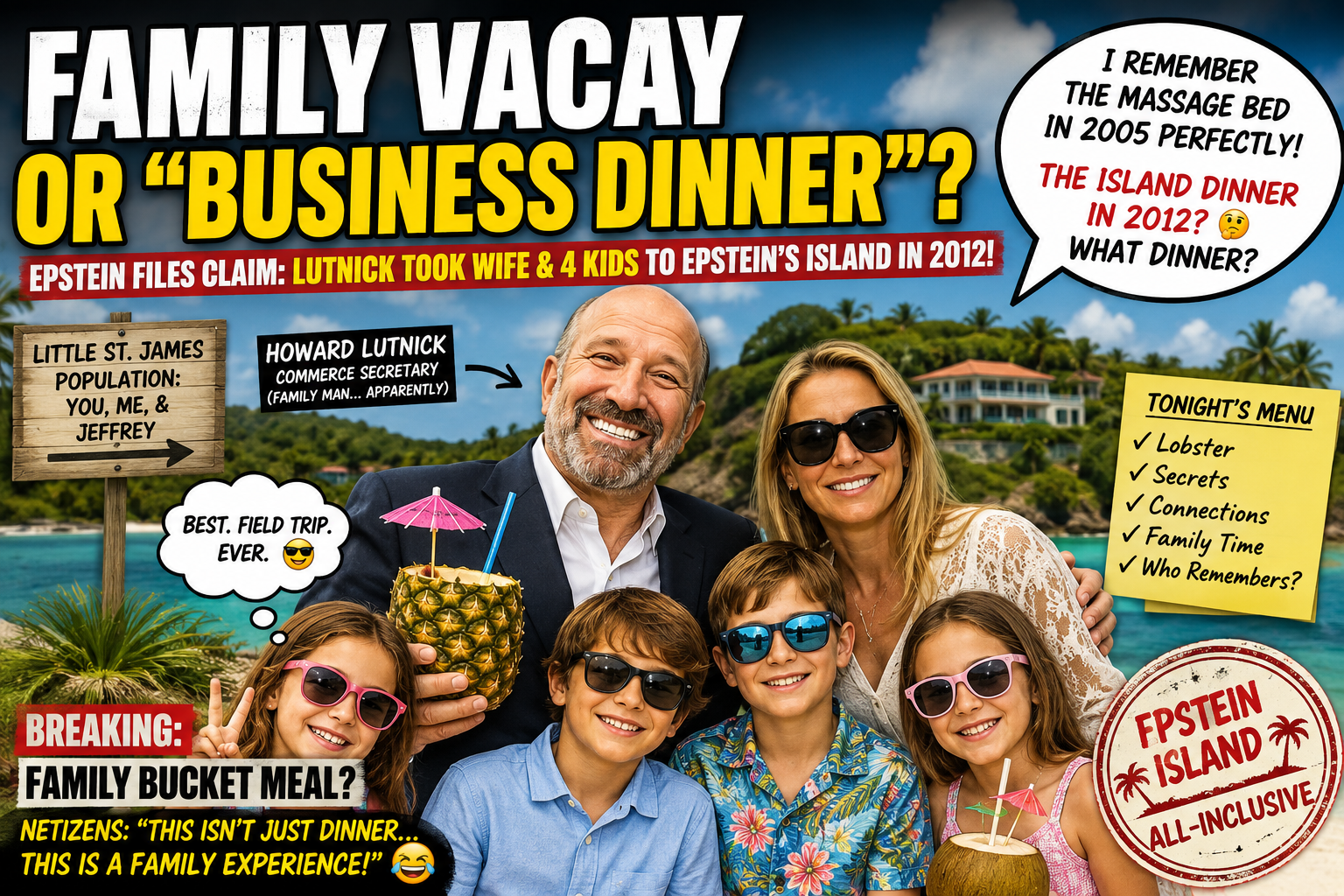
And then came the part that turned a slow burn into a viral wildfire: claims that in 2012, Lutnick, his wife, and children may have visited Epstein’s private island, Little St. James.
Now, whether this is a literal reading, an exaggeration, or a misreading of fragmented references is still debated—but online, nuance rarely survives the first repost.
The keywords Little St James, emails, and Lutnick quickly became inseparable from the story, forming a trending trio that fueled endless threads and speculation.
“Family Dinner on the Island” — The Meme Writes Itself
If there is one thing the internet cannot resist, it is turning controversy into comedy.
The idea—whether fully accurate or heavily distorted—that a family dinner may have taken place on Epstein’s island instantly became meme material.
Users dubbed it everything from “Epstein Family Pack” to the now-infamous “family bucket meal,” a phrase that spread faster than the original claims themselves.
The Epstein Files stopped being just a document dump and became a cultural punchline generator. The keywords Epstein Files, Epstein, Commerce Secretary, Lutnick were suddenly as likely to appear in jokes as in political commentary.
Congressional Questioning and the “Goldfish Memory” Narrative
The story took another turn when online users began resurfacing snippets of congressional testimony. In these interpretations, Lutnick is portrayed as clearly remembering earlier events but expressing uncertainty about later ones.
Supporters argue this is being taken out of context. Critics, however, saw it as a perfect example of what internet culture now calls “selective memory syndrome.”
One viral comment summed up the mood:
“He remembers the massage bed like it was yesterday, but the island dinner? Total blackout.”
Again, these are internet interpretations, not verified findings—but in the age of the Epstein Files, interpretation often travels faster than fact.
Why the Story Blew Up So Fast
Part of the reason this narrative spread so rapidly is simple: it contains all the ingredients of viral political gossip.
You have:
- A powerful figure (Commerce Secretary)
- A controversial historical name (Epstein)
- A mysterious location (Little St James)
- Leaked communications (emails)
- And a timeline that feels intentionally confusing
Mix those together, and the Epstein Files become less of a document release and more of a global guessing game.
Keywords like Epstein Files, Lutnick, and Epstein aren’t just search terms anymore—they’re entry points into a sprawling online storytelling ecosystem.
The Internet’s Favorite Sport: Connecting Dots
As always, social media users began connecting dots—sometimes carefully, sometimes creatively, and sometimes with full artistic freedom.
Some threads framed the situation as a hidden timeline. Others treated it like a political thriller. A few simply posted memes with captions like “Bring your kids, it’s a business dinner.”
The truth is that the Epstein Files function less like a single narrative and more like scattered puzzle pieces. And when you scatter enough pieces online, people will always assemble their own picture—accurate or not.
Conclusion: Where Fact Ends and Internet Begins
At the center of it all is a familiar modern phenomenon: documents are released, interpretations explode, and online culture fills in the gaps with equal parts curiosity, suspicion, and humor.
Whether the claims about Lutnick and a 2012 island visit are accurate, misinterpreted, or exaggerated remains a matter of ongoing debate. What is undeniable, however, is how quickly the story became part of the Epstein Files mythos.
And in that mythos, keywords like Epstein Files, Lutnick, Commerce Secretary, Epstein, Little St James, emails don’t just describe a story—they become the story.
In the end, the internet doesn’t just read the news.
It remixes it.